
Martech migrations are often positioned as technical upgrades. A new platform. Cleaner data. Better integrations.
But most marketers know the real pressure isn’t the software. It’s the expectation that performance won’t slip while everything underneath it changes.
Campaigns still need to launch. Leads still need to convert. Dashboards still need to report accurately to leadership. And customers should never feel the disruption.
That’s why the success of a martech migration rarely hinges on technology alone. It hinges on how people experience the transition.
A successful migration is a people-centered transformation that requires clarity, capability and shared accountability at every stage. When organizations stabilize workflows, protect institutional knowledge and support teams through the strain of change, the new platform delivers what it promised: long-term value, operational scalability and a stronger marketing foundation.
Related Content: Five Considerations for Choosing a Marketing Automation Software
Migration is Change Management in Disguise
Migration disrupts more than technology. It disrupts routine and familiarity. The processes teams once executed with confidence now require second-guessing. Familiar tools give way to unfamiliar interfaces, and certainty is replaced with hesitation.
Without a people-first strategy, confusion grows, workarounds multiply and teams burn out bridging the gap between old and new systems.
A people-first migration reframes the experience. Instead of asking teams to simply figure it out, leaders guide them through what’s changing, what they need to learn and how their day-to-day work will evolve. That clarity builds confidence, and confidence fuels adoption.
“When a system changes, people don’t just lose a tool. They lose familiarity. They lose the confidence that comes from knowing exactly how to get their work done. Leaders who recognize that shift and provide structure create stability in the middle of disruption,” says Susan Reising, Simantel’s director of organizational health.
When migration is treated purely as a technical deployment, behavior rarely shifts. The real milestone is not go-live. It’s when teams integrate the new system into how they actually work.
Clarity Creates Confidence
One of the most common sources of friction during a migration is uncertainty. Teams want to know:
- What exactly is changing?
- What is staying the same?
- How will this impact my role, my timelines and my responsibilities?
Clear communication removes that uncertainty. When leaders outline expectations, align priorities and clarify responsibilities, teams gain a sense of control.
Clarity also protects performance. When ownership is established and escalation paths are clear, teams avoid duplicate work, reporting gaps and costly errors. That stability reduces revenue risk, safeguards customer experience and maintains leadership confidence.
Skill Building Keeps Work Moving
A new martech platform is only as powerful as the people using it. Marketers need time, training and support to build the skills required to keep campaigns running smoothly during and after the transition.
That means more than a one-time training session. Effective migrations include:
- Role-specific support that reflects real workflows
- Hands-on learning tied directly to active campaigns
- Accessible documentation teams can reference when questions arise
For example, if a demand generation team is building nurture streams during migration, their workflows and training should reflect that exact activity. Instead of walking through generic platform features, teams should practice building, testing and launching live nurture programs inside the new system. Learning inside the production environment accelerates proficiency and keeps execution moving.
Over time, that approach builds more than competence. It builds confidence. Teams operate with greater independence, and the marketing function emerges stronger than it was before the transition.
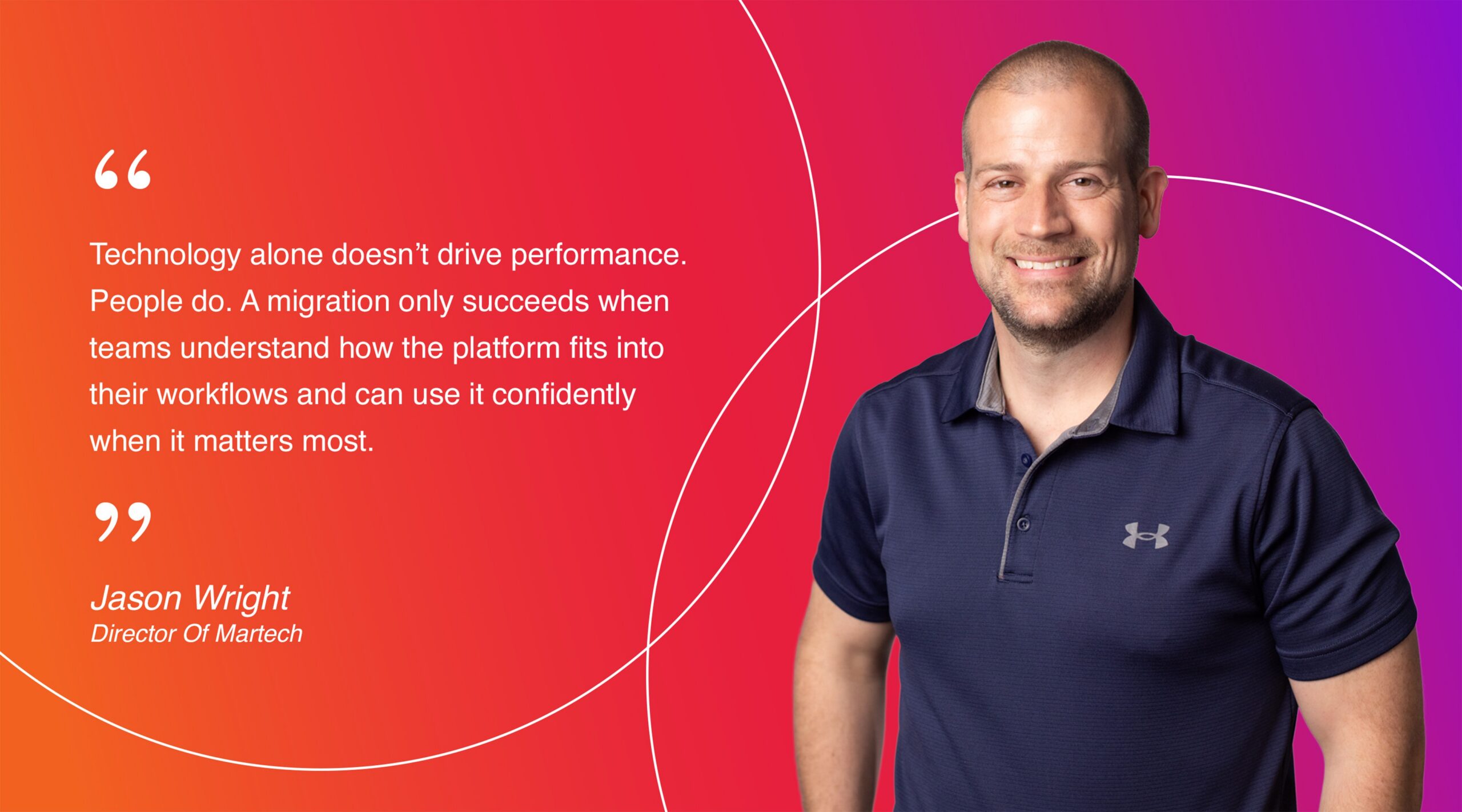
“Technology alone doesn’t drive performance. People do. A migration only succeeds when teams understand how the platform fits into their workflows and can use it confidently when it matters most. Our role is to align the system with the way people actually work so momentum stays strong, and customer experience never misses a beat,” says Jason Wright, Simantel’s director of martech.
Stabilize Workflows to Prevent Chaos
Workflows are especially vulnerable during transition. Steps that once felt automatic can break. Approvals slow down. Dependencies become unclear. This is the messy middle, the space between old and new where uncertainty can disrupt momentum.
Preventing disruption starts with documenting and validating existing processes before making changes. Teams should identify which workflows must remain stable to protect performance, then prioritize updates in phases rather than all at once.
From there, organizations can modernize deliberately by removing redundancies, clarifying ownership and retiring legacy processes that no longer serve the business. Migration becomes less about blowing up the past and more about strengthening what works while intentionally improving what does not.
The result is a marketing operation that stays steady through change and emerges stronger on the other side — easier to manage, clearly governed and built to scale.
Preserve Tribal Knowledge
Every marketing team relies on tribal knowledge: the unwritten rules, shortcuts and historical context that keep campaigns moving and performance steady. During migration, this knowledge is especially vulnerable. When systems change, the reasoning behind decisions, naming conventions and workflow nuances can disappear with them.
Capturing that insight before transition reduces confusion, rework and costly slowdowns. Playbooks, hands-on walkthroughs and detailed documentation translate institutional knowledge into shared understanding. The payoff extends well beyond migration.
Alignment is the Ultimate Accelerator
Martech migrations sit at the intersection of marketing, sales, IT and leadership. When alignment is strong, decisions move faster. Tradeoffs become strategic instead of reactive. Teams operate from shared priorities rather than competing timelines and feel supported instead of siloed and adopt new systems with confidence.
Bringing sales into the conversation early ensures lead definitions, handoffs and reporting structures remain consistent throughout the transition. This coordination protects the project while keeping the customer experience front and center.
That cross-functional collaboration often becomes one of the most valuable outcomes of the migration — strengthening relationships and increasing long-term platform adoption, which drives sustained performance.
Related Content: 4 Tips For Your Marketing Automation Migration
Addressing Change Fatigue Matters
Even well-planned migrations add strain. Teams are often managing “business as usual” alongside transformation work, and that pressure adds up.
Leaders who acknowledge the extra effort, set realistic expectations and prioritize what truly matters prevent migration from feeling like just another burden. When people feel supported, performance stabilizes. When they’re overwhelmed, results slip.
Sustainable pacing is a leadership decision. Prioritizing critical milestones, adjusting timelines when needed and acknowledging the additional lift required all signal respect for the people doing the work.
Susan explains, “Even high-performing teams feel the strain of balancing transformation with business as usual. Sustainable change requires pacing, reinforcement and visible leadership support. When those elements are in place, teams build new habits that last.”
How Simantel Approaches Martech Migration
We’ve guided organizations through complex martech transitions in addition to navigating our own internal platform evolution.
We approach migration as both an operational transformation and a human one. That means:
- Defining clear governance and decision-making structures early
- Mapping workflows before rebuilding them
- Designing role-specific enablement tied to real, day-to-day work
- Aligning marketing, sales, IT and leadership around shared outcomes
- Protecting institutional knowledge so momentum is not lost
Our role is to simplify complexity while building capability within teams. We believe technology should empower people to move faster and smarter, not overwhelm them.
When migration is orchestrated intentionally, organizations reduce tech debt, strengthen cross-functional alignment and establish a cleaner, more scalable marketing foundation. Teams emerge more capable. Processes become more intentional. And the organization is better positioned to adapt to whatever comes next.
That’s the human side of martech migration. And it’s where long-term value is built.
If you’re planning a martech transition and want a partner who understands systems and the people who power them, we’d love to connect.