

When marketing budgets get tighter, conversations tend to get practical fast.
What can we still do? What needs to wait? What can we reuse? What will actually move the needle? And, inevitably, can this just be an email? Sometimes, yes. Often, no. Please do not make everything an email.
For complex organizations, the smartest budget move is not always reducing the work, but reducing the ambiguity around what the work is meant to solve. Budget pressure is real, and many teams are being asked to support the same business goals with fewer dollars, shorter timelines or more scrutiny. That can feel limiting, but it can also force the kind of focus that good strategy should create anyway. A smaller marketing budget does not mean smaller thinking, just sharper choices.
The risk is spreading limited resources across too many disconnected efforts and hoping they add up to impact. A sales sheet there, a small paid push, a landing page refresh, a social post because “we should say something.” None of those things are wrong on their own, but if they are not connected to a clear business priority, they are just activity.
Activity ≠ momentum.
Before You Cut Marketing Tactics, Clarify the Business Problem
When resources are tight, it is tempting to start with tactics because they can feel concrete. Tactics give teams something to estimate, create and check off the list, but the better starting point is the business problem.
Are we trying to help defend value in a price-sensitive conversation? Increase adoption of an offering? Support dealers, agents, distributors or partners who carry the message into market? Those are all very different jobs.
And in industries like manufacturing, heavy equipment, industrial services and insurance, the job is rarely straightforward. The audience is often layered and the decision carries risk. The buying process may involve multiple people, internal politics, operational realities and a healthy amount of “we’ve always done it this way.”
So before deciding what to refresh or promote, we need to define what needs to change. What does the audience need to understand, believe or do differently for the business to move forward?
That question is where tighter-budget marketing strategy should start.
Related Content: Marketing Triage: Rapid Strategic Planning
Put Your Marketing Investment Where It Can Actually Move the Business
Focus can feel uncomfortable, especially when everything on the list matters, but a constrained budget cannot support every priority equally. Trying to give every audience, product, message and channel a little attention usually leads to work that feels busy and not as effective. The goal is not to do less for the sake of doing less.
If the biggest barrier is sales confidence, focus there. If the biggest opportunity is customer retention, build around value and reassurance. If partners are the strongest path to growth, prioritize alignment and clarity. If prospects understand the category, but not your advantage, sharpen the differentiation.
This is where strategy has to be useful. Not theoretical — useful.
Strategy should help teams make decisions, tradeoffs and recommendations with a clear reason behind them. It should provide your team clear direction: what to do, what not to do and why. “A little bit of everything” sounds safe, but it usually just makes the budget work harder than it should.
The Customer Insights You Need May Already Be Inside the Business
Most organizations are sitting on more useful insight than they realize!
Five common ways to uncover insights without formal research:
- Sales teams know where conversations stall.
- Customer service teams know what people misunderstand.
- Dealers, agents and distributors know which objections come up again and again (and they’re usually happy to share how marketing can help them).
- Product teams know where the real differentiation lives.
- Customers show what they value through the questions they ask and the feedback they share (even if that means exploring a new channel to find it. Hello, Reddit!
That knowledge is valuable, and it is also often underused. When marketing budgets are tighter, one of the smartest moves is to mine what the business already knows and turn it into clearer direction.
Four ways feedback can strengthen your marketing strategy:
- A recurring objection can become a stronger value story.
- A customer pain point can reveal a better message.
- A partner question can expose an education gap.
- A high-performing piece of content can show what the market is already responding to.
This is not about dusting off old materials and calling it a strategy. It is about finding the strongest material and making it work harder against your business goals. Sometimes the opportunity is not to create something entirely new, but to say the right thing more clearly ~ to the right audience ~ at the right moment.
Related Content: Inside Content Strategy: What It Is and Why You Need It
Before You Add More Marketing Activity, Find the Friction
When marketing performance feels soft, the instinct is often to add MORE.
More messages. More channels. More touchpoints. More content. More meetings about the content. A bold and timeless tradition (raise your hand if you have ever had a meeting about a meeting).
Ask these questions to look for real problems to solve:
- Where are people getting stuck?
- Where is the message unclear?
- Where does the sales conversation lose momentum?
- Where do customers hesitate?
These moments may seem small, but they can quietly weaken everything else.
If a prospect understands the product, but not why it matters to their business, more promotion may not solve the problem. If a partner wants to advocate for the brand, but cannot explain the story consistently, more supporting material may not help unless the message is clear first.
Reducing friction can be one of the most efficient ways to improve marketing impact because it makes the work that’s already happening more effective — and in a tighter-budget environment, that matters.
Related Content: How to Get Actionable Insights From Raw Data
A Simple Strategy Tool for Smarter Marketing Budget Decisions
Instead of asking “Can we do this?” ask “Should we do this, and what will it help the business accomplish?” Use this filter to pressure-test whether an effort is solving the right problem or just adding more activity.
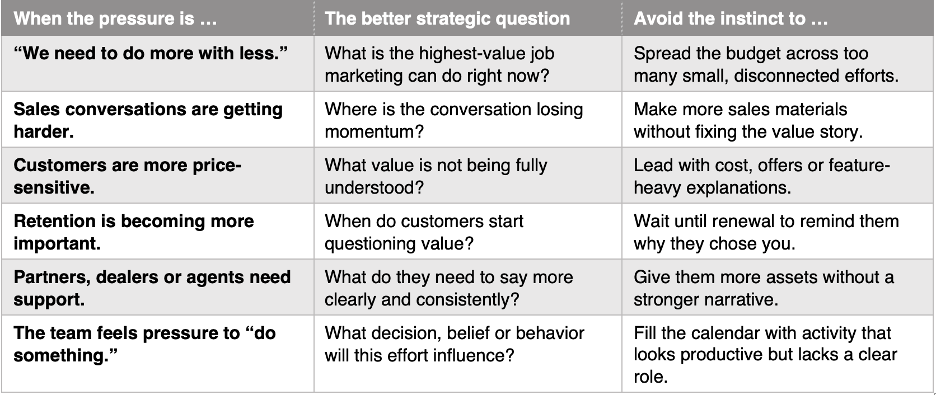
Make Every Marketing Decision Prove Its Role in Business Impact
A smaller budget does not mean marketing should get timid. It means every move needs a clear role. Maybe that role is helping a buyer feel more confident, helping sales have a better conversation or helping a partner tell the story consistently.
The point is not to chase the cheapest option. Cheap work that does not solve the right problem is still waste. Instead, the point is to make intentional choices that connect marketing activity to business impact.
That is the difference between doing less and doing what matters.
When budgets are tight, strategy has to work harder. It must create focus and help teams invest where the opportunity is strongest. Smaller budgets do not need smaller ambition, just sharper strategy.
Bring us the business challenge, audience tension or growth opportunity you are working through. We can help sharpen the strategy and prioritize the work that moves the business forward.