
Let’s play a little game. You walk into a room of marketers, sales folks and IT partners and ask, “How many leads did we get last month?” Now, brace yourself for the chaos.
Marketing might say 2,000 (counting anyone who filled out a form). Sales might say 200 (only including those who got past a discovery call). IT might ask what table you’re pulling from. And someone in the back will mumble, “Define lead …”
Welcome to the beautiful mess that is modern marketing data.
As someone who spends a lot of time helping organizations align people, process and platforms, I’ve seen firsthand how today’s marketers are doing heroic work — sifting through tangled data threads just to create something as simple as a campaign performance report. We’re expected to deliver insights, personalization and measurable ROI, all while pulling data from more systems than we can count on two hands. And those systems? They don’t exactly play nice.
So let’s talk about it. Here are the top challenges marketers face trying to wrangle disparate data — and some practical ways to start making sense of the mess.
Challenge #1: Data Definitions — Everyone’s Using the Same Words, But No One Means the Same Thing
Let’s go back to our “lead” example. Or how about “conversion”? Or “engagement”? I’ve seen teams nod along like they’re on the same page, only to later realize one team defines “engagement” as time on site, another as email clicks and another as social media reactions. Yikes.
These semantic differences cause real problems. Without consistent definitions, your dashboards become a game of telephone — and your strategy? A bit of a guessing game.
The Fix: Create (and Maintain) a Marketing Data Glossary
Start small. Identify your core marketing metrics and document exactly what each one means, how it’s calculated and where the data comes from. Don’t do this in a silo — bring in stakeholders from sales, IT and analytics. This is less about “owning” definitions and more about co-authoring a shared language.
Then, put that glossary somewhere accessible (and ideally, version-controlled). Trust me: this one document can save dozens of hours and prevent countless misunderstandings down the road.
And you’re not alone in this challenge. According to a 2023 Gartner survey, 44% of CMOs say inconsistent data across teams is a major barrier to marketing success. That’s nearly half of us. Turns out you are not the only one Googling “Why do my dashboards lie to me?”
Challenge #2: Stitching Together Unlike Data Sources — Because Who Doesn’t Love a Frankenstack?
Your marketing tech stack probably includes your website analytics platform, CRM, email automation tool, social media scheduler and maybe a campaign management platform or two. Each tool serves a specific purpose, but very few of them speak the same language — or structure their data in ways that make integration easy.
And the more tools we add (because who isn’t chasing the dream of hyper-personalization?), the harder it gets to see the big picture. Suddenly, we’re exporting CSVs at midnight, hoping Excel doesn’t crash under the weight of our VLOOKUPs or building deeply complex data normalization workflows in our not so singular “single source of truth” data warehouses and data lakes.
The Fix: Start with Strategy Before Technology
We often rush to solve data problems with new tech. But before you invest in yet another platform promising “seamless integration,” take a step back.
Ask:
- What are the critical questions we’re trying to answer?
- What data do we already have — and where does it live?
- Where are the gaps that are truly business-critical?
Then, work with your technology and analytics teams to build out a data architecture that prioritizes those needs. That might include middleware, APIs or a customer data platform (CDP) —but the key is to lead with strategy, not software.
Also: lean into your IT partners. They are wizards at solving technical puzzles and often have visibility into solutions that marketing might not know exist. And don’t underestimate the power of a good ol’ consultant who has seen problems like yours and has practical advice about how to prevent the many pitfalls of any data migration or aggregation undertaking.
For context: a recent Forrester study found that 57% of marketing leaders say integrating multiple data sources is their biggest challenge when trying to deliver personalized customer experiences. So if your data stack feels more like a Jenga tower, you’re in excellent company, but also danger …
Challenge #3: Seeing the Whole Picture — Users and Experiences
Imagine this: you’ve built the perfect customer journey map. It shows every touchpoint, from awareness to conversion and beyond. You’ve layered in data — clicks, opens, sessions, purchases. But something’s still off.
You can’t connect the dots across devices. You don’t know what happened after the ad click but before the call to sales. You can’t tell if that webinar attendee actually became a customer. The view is fragmented.
This is where so many marketing teams hit a wall. They have pieces of the puzzle but no way to see how it all fits together.
The Fix: Embrace Identity Resolution and Experience Mapping Together
This is where identity resolution comes in — tying together user behaviors across platforms, sessions and even devices into a unified customer profile. Platforms like CDPs or DMPs can help with this, but you don’t have to go all-in on expensive solutions right away.
Start with what you can control. Ensure that tracking parameters (UTMs, cookies, user IDs) are consistent across your channels. Use CRM data to close the loop on known users. And work closely with your analytics team to align on customer journeys — not just in theory, but in measurable paths.
Then, revisit your experience maps. Are they grounded in data? Are they capturing emotional moments, not just clickstreams? And are you using them to influence both content and measurement?
According to Salesforce’s State of Marketing report, 78% of high-performing marketing teams say a unified customer view is critical to their success. And yet, only 30% say they can actually achieve it consistently.
So, yes — it’s hard. But it’s worth it.
Bonus Advice from the Field: People Make Data Work
We can’t talk about data unification without talking about the people who make it happen. Data isn’t just a tech problem — it’s a team sport. The most successful marketing organizations I’ve worked with are the ones that invest in cross-functional collaboration and shared ownership.
That means:
- Building bridges between marketing, IT, sales and analytics.
- Prioritizing regular data reviews where everyone’s invited — not just the “data people” because context is everything.
- Giving teams the why behind the dashboards, not just the what.
Sometimes the biggest win isn’t the perfect integration — it’s a shared understanding of what success looks like, and a willingness to evolve together.
Learn More: Collaborating for Bigger Wins
In Summary: You’re Not Crazy. This Is Hard.
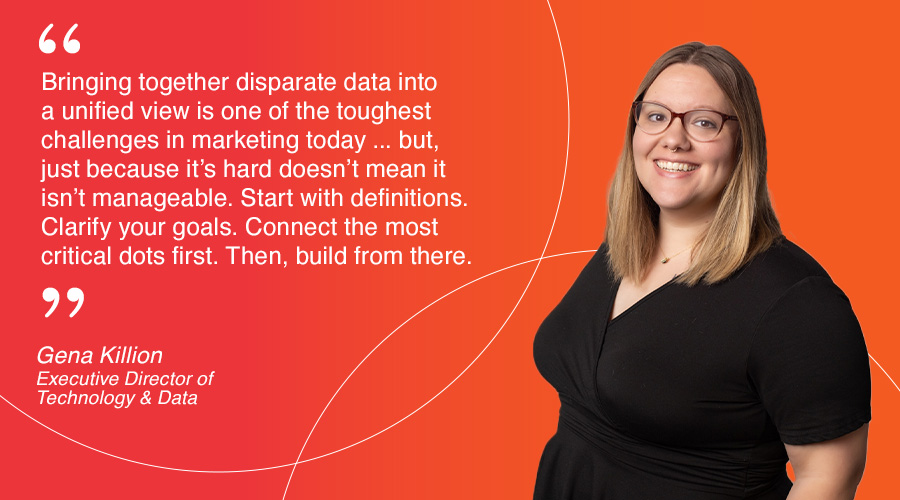
Bringing together disparate data into a unified view is one of the toughest challenges in marketing today. You’re trying to translate messy, inconsistent, often incomplete information into beautiful, actionable insights. And you’re doing it while juggling campaigns, content, stakeholders and the ever-changing whims of the algorithm gods.
But here’s the good news: just because it’s hard doesn’t mean it isn’t manageable.
Start with definitions. Clarify your goals. Connect the most critical dots first. Then, build from there.
And when in doubt, find your people — the ones who love a good data dictionary, who geek out over clean schemas, and who believe that yes, marketing can be both creative and operationally sound. If you don’t know those people, let’s connect! Our nerds love this stuff (sincerely, one of said nerds).